
Buying guide
Siphon coffee: vacuum pot gear and when it fits
How vacuum pots brew, gear needs, and when pour-over is simpler.
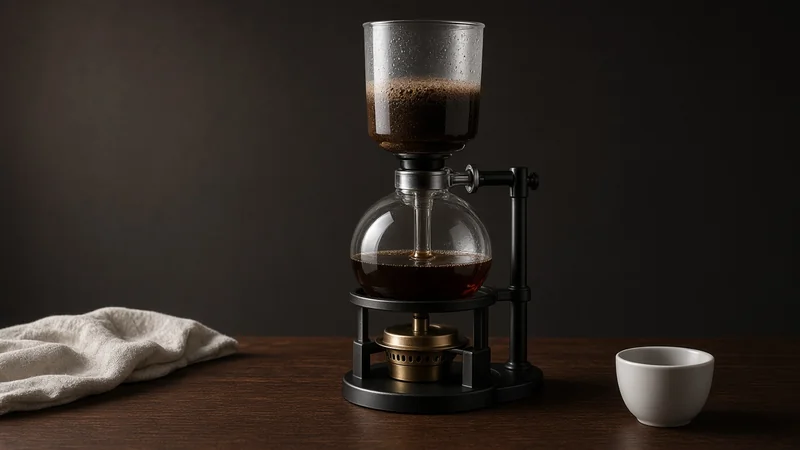
Siphon brewers move water with vapor pressure and vacuum. Expect more cleanup than pour-over. Use them for the ritual; use a dripper when you want clarity with less gear.
- Vapor pressure then vacuum moves the water.
- More glassware and heat management than a dripper.
- Choose for ritual; choose pour-over for similar clarity with less fuss.
Vacuum brewing mechanics
Siphon (vacuum) brewers heat water in a lower globe until vapor pressure pushes it into an upper chamber holding coffee. After heat is removed, cooling vapor pulls the brew back down through a filter.
The process is immersive with a dramatic drawdown. It rewards attention: timing, grind and filter cloth or paper choice all show up in the cup.
Glass assemblies break if thermal shocked or tipped. Give them a dedicated safe corner.
Burners, beams and electric bases
Butane burners, alcohol lamps and electric bases all appear in home kits. Electric bases simplify indoor use; open flame needs ventilation awareness.
Stabilize the stand before lighting anything. Keep cords and curtains away from burners.
Preheat thoughtfully so joints are not forced while cold.
Filters and cleaning
Cloth filters impart a different body than paper inserts. Rinse cloth thoroughly and store per maker guidance so they do not sour.
Demount carefully after cool-down. Coffee oils on glass look scenic and taste stale next round.
Who should bother
Siphon fits people who enjoy ritual and have shelf space for fragile glass. It is a weak weekday choice for rushed households.
If you want immersion with less theater, French press or AeroPress is simpler — compare via brew methods.
Keep a towel and a safe landing zone; broken glass ends the brew session immediately.
Safety notes
Never seal mismatched parts from different kits. Use heat-safe pads under burners. Extinguish flame before walking away.
Allow full cool before cleaning. Forced cooling with cold water on hot glass risks cracks.
Use a recipe for the actual capacity
Hario publishes a Morgan Eckroth siphon recipe with 36 g of coffee, 560 ml of water and a brew time around 2:30. Those are the published recipe figures, not a universal timing law for every vacuum brewer. Use a vessel that can safely accommodate the recipe rather than filling a smaller globe beyond its mark.
Follow the recipe’s linked method and your brewer’s manual for the timing start point. Heating time, immersion time and total time are different measurements. Writing only “brew time” without the start event makes comparisons ambiguous. Weigh the dry dose, measure the water before heating and record the grind so a later adjustment has a meaningful baseline.
Fit the filter and inspect the joints
Begin with cool, undamaged glassware. Look closely at the lower globe, stem and mating surfaces for chips or cracks. The stand must hold the globe securely, and the upper assembly must be compatible with it. Do not mix pieces simply because the joint seems to fit. Use the supplied filter holder and fastening arrangement.
Wet and prepare the filter as its instructions specify. An unevenly seated filter can let particles bypass it, while a clogged cloth can slow the return flow. Check that the retaining attachment is positioned correctly before introducing hot water. Reserve a heat-safe place for the upper chamber after brewing; it is awkward, hot and easy to knock over.
Watch the transfer rather than only the clock
Heating the lower chamber raises pressure and moves water up the stem. Reduce and manage heat according to the brewer’s method once transfer occurs, rather than assuming the burner should remain at maximum. Wet the coffee evenly in the upper chamber and keep agitation repeatable. Aggressive stirring changes both extraction and the movement of fines toward the filter.
When the method calls for removing the heat source, the lower chamber cools and the pressure difference draws coffee back down. A little liquid remaining below during the rising phase is not automatically a defect. Unusual bubbling, failure to transfer or an unstable assembly deserves a safe stop and inspection after cooling, not a forced adjustment to hot glass.
Diagnose slow drawdown and sediment
If drawdown slows, examine grind and filter cleanliness before extending the next steep. A clogged filter and an overly fine grind can both delay separation, but they need different remedies. Compare with a clean correctly seated filter, then adjust the grind. Do not try to unblock the hot stem with a utensil during operation.
Sediment can come from a poorly seated filter, worn cloth or agitation that drives fine material through the filtering surface. A dull or sour cloth smell points to cleaning and storage. Check the manual’s instructions for reusable filter care; do not store it wet in a closed cabinet by habit. Filter quality is part of the process, not an accessory detail to ignore.
Who should own the ritual
A siphon makes sense for a person who wants to observe extraction and will reserve space for glassware, a stand and filter care. It is a poor default for a crowded counter with children reaching across it, an office queue or a rushed commute. A French press provides immersion with fewer fragile parts, and paper pour-over provides clarity without a heated globe.
Buy only when replacement globes, seals and filters are available for the model. Check the permitted indoor heat source and building rules before choosing a burner. The attractive display is not the whole ownership experience: safe cooling, disassembly, drying and storage happen after every cup. If those tasks do not fit the routine, choose a simpler brewer instead.
FAQ
Why does the coffee take so long to draw down?
Inspect the filter for clogging and correct seating, then evaluate whether the grind is too fine. Compare with a clean filter before changing the next brew. Never try to clear the stem with a utensil while the brewer is hot.
Can I cool the hot lower globe under cold water?
Do not force-cool hot glass. A sudden temperature change can crack it. Remove the heat source as the brewing method directs, keep the assembly stable and allow it to cool before disassembly or cleaning.
Can I mix upper and lower chambers from different kits?
Use only parts the manufacturer identifies as compatible. A joint that appears to fit is not proof of a safe assembly. Inspect cool glass for damage and check the stand, seals and filter attachment before heating.
Next step
For Siphon coffee: vacuum pot gear and when it fits, compare bands on tiers or run the matcher once.
Sources
Spec notes for Siphon coffee: vacuum pot gear and when it fits are compiled from maker docs and public references — not a hands-on review. Confirm live specs before buying.