
Buying guide
Drip coffee maker buying guide
Temperature, showerheads, carafes and capacity.
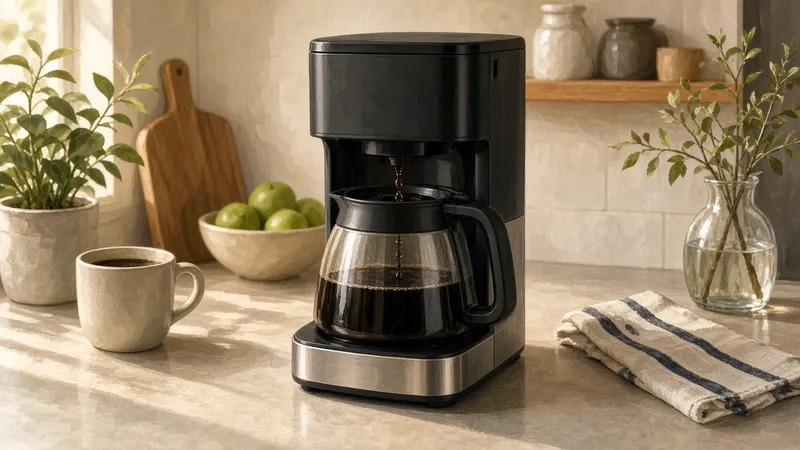
- NCA’s published pour-over method gives 93 ± 3°C water; automatic machines need their own documented brew controls.
- Showerhead design affects how evenly grounds are wetted.
- Thermal carafes avoid a hot plate that can scorch coffee.
What actually changes the cup in drip machines
Drip coffee looks simple: heat water, shower it over a bed, collect in a carafe. The details that matter are brew temperature stability, how evenly the showerhead wets the grounds, whether the machine pauses for a bloom, basket shape, and whether the carafe is thermal or sits on a hot plate.
Industry materials from the Specialty Coffee Association discuss temperature and extraction windows for filter coffee. Home machines vary in how closely they hold those windows across a full carafe.
Hot-plate carafes can cook coffee if it sits. Thermal carafes keep temperature without continuous heat under the brew — useful when people pour over an hour.
Basket shape, filters and dose limits
Flat-bottom and cone baskets wet differently. Flat beds can be more forgiving of cascade showerheads; cones sometimes need a more centered spray. Use the filter type the basket expects — #4 cone papers are not interchangeable with flat baskets.
Basket capacity limits dose. A reservoir’s nominal cup label may not match your mug. Weigh water into the reservoir when you care about ratio, and confirm the basket can hold the matching coffee dose without mounding into the showerhead.
See Coffee-to-water ratios by method for starting math. Check the SCA certified-brewer directory for current model status.
Thermal versus glass carafes
Thermal stainless carafes favor taste over time if you brew a full batch for a household. Glass carafes show volume remaining but often rely on a warmer plate.
Preheat thermal carafes with hot water when the kitchen is cold; a chilly vessel pulls heat from the first cups. Rinse daily — stale oils in the carafe flavor tomorrow’s brew more than people expect.
If you only brew one or two mugs, a smaller dripper or pour-over may waste less coffee than a large drip machine run half-empty.
Features worth paying for — and skipping
Worth a look: consistent heating, even showerhead, thermal carafe, accessible brew basket, descaling pathway documented in the manual. Optional niceties: programmable start, water filter slot, bloom pause.
Often skippable for taste: extravagant LED panels, built-in grinders that are hard to clean, and single-serve “pods for drip” adapters unless convenience is the real goal.
Built-in grinders sound tidy but couple two failure modes. Many households prefer a separate burr grinder — see Building a first coffee kit: grinder, brewer and upgrades.
Water, scale and weekday maintenance
Hard water scales heating elements and shower holes. Follow the maker’s descaling product and interval. The US EPA drinking water pages explain hardness and treatment at a household level; coffee gear simply inherits your tap chemistry.
Empty the carafe and basket after breakfast. Monthly deeper cleans keep plastic hoppers and gaskets from smelling stale.
Chlorine taste in tap water is a carbon-filter pitcher problem more often than a machine problem. Deep dive: Water for coffee: why it matters.
Sizing the machine to your mornings
Count real mugs, not labeled cups. Count how many actual mugs the household fills, including refills, before choosing a carafe.
Offices and households with staggered wake times may prefer a thermal batch brew left on the counter — see Shared coffee setups: households, small kitchens and offices and Shared coffee setups: households, small kitchens and offices.
Small kitchens should measure depth including the carafe handle swing. Catalog dimensions are in deals cards.
What certification is trying to signal
SCA coffee-equipment certification programs evaluate whether a machine can meet published brew-performance criteria (temperature, time, uniformity and related factors) under test conditions. Exact program names and model lists evolve — verify current status on sca.coffee and the maker’s product page.
Certification is a useful filter, not a flavor guarantee. Beans, grind, ratio and freshness still dominate.
How to shop using the badge
Confirm the exact model name matches any certified list. Revisions sometimes differ. Then still check carafe type, footprint and basket style for your kitchen.
When an uncertified machine is fine
If cups taste good with even grinding and sensible ratios, you do not need to chase a badge. Upgrades should target a clear fault (baked hot-plate taste, uneven saturation, tiny baskets).
Read a real small-batch specification
The OXO Brew 8-Cup page describes a single-serve accessory and brewing directly into a mug as well as a thermal carafe. That is a practical distinction from simply reducing the water in a large basket. If you alternate between solo breakfast and a family pot, look for an explicit supported small-batch path in the documentation.
Check the cabinet clearance with the lid raised, not only the closed machine height. Find out whether the reservoir can be filled without sliding the brewer, and whether the basket can be removed while the carafe is parked. Those movements are part of the daily footprint. A machine that fits on paper but must be dragged across the counter every morning is not a compact solution.
FAQ
Do I need an SCA-certified machine?
Certification signals the machine met a published brew-performance checklist at certification time. It is a useful filter, not the only path to good drip. Verify current model status on the maker or SCA materials.
Paper or permanent filter?
Paper usually tastes cleaner; permanent mesh passes more oils and fines. Rinse mesh thoroughly.
Why is the coffee bitter by the second hour?
Hot-plate holding cooks coffee. Brew into a thermal carafe or brew smaller batches more often.
Can I use pre-ground coffee?
Yes, with medium drip grind. Freshly ground burr coffee still improves aroma and sweetness for most beans.
Next step
For Drip coffee maker buying guide, compare bands on tiers or run the matcher once.
Sources
Spec notes for Drip coffee maker buying guide are compiled from maker docs and public references — not a hands-on review. Confirm live specs before buying.