
Buying guide
Beginner espresso: setup, dial-in and milk workflow
Realistic first setups from maker specs, with budget splits that do not starve the grinder.
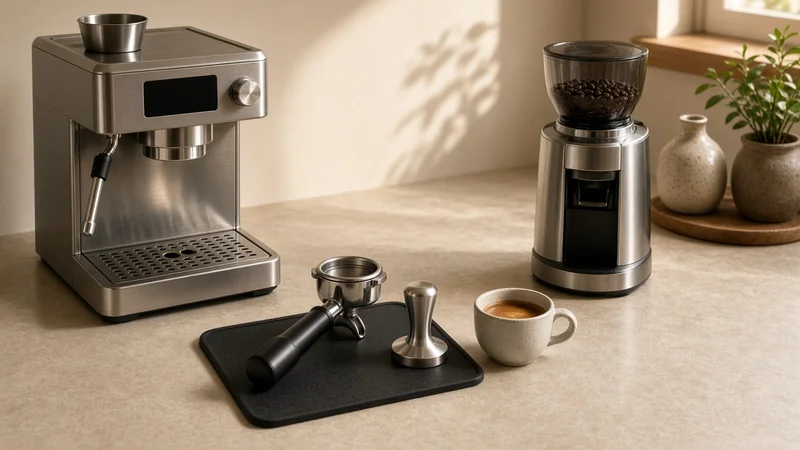
For a first semi-auto, spend seriously on an espresso-capable grinder, then pick a compact machine. Or choose a super-automatic if you want button drinks with less technique.
- A capable grinder is mandatory for semi-autos.
- Compact thermoblock machines lower the entry barrier.
- Super-autos trade control for push-button convenience.
The non-negotiable: grinding
Espresso exposes grind defects immediately. Budget for an espresso-capable grinder beside or built into the machine. Pressurized baskets buy forgiveness while you learn; plan a path to non-pressurized baskets.
Read Coffee grinder buying guide: burrs, blades and method fit before falling for chrome.
Machine class for first machines
Compact thermoblock or single-boiler semi-autos teach puck prep without filling the kitchen. Super-autos and capsules optimize convenience instead of skill — pick the goal honestly.
Basket type, dosing guidance and brewing controls should come from the particular machine’s documentation. Do not assume one traditional recipe fits every home basket.
Starter accessory list
A scale that fits the drip tray, tamper that fits the basket, milk pitcher if you steam, cleaning brush, and maker-approved cleaner. Knock box optional but tidy — catalog example on deals.
Skip twelve gadgets on day one. Add distribution tools after you can repeat basic shots.
Water and cleaning from day one
Use suitable water and descale on schedule. Backflush if your machine supports it — Cleaning coffee gear: brewers, grinders and espresso care.
Purge steam wands immediately after milk.
Space and expectation setting
Measure depth including the portafilter sticking out. Espresso kits sprawl.
Expect a learning curve. Good notes beat buying a second machine in month one.
Dose, yield, time as a loop
Dose is dry coffee in the basket. Yield is liquid out. Time is how long the shot runs. Grind ties them together by resisting flow.
Use the NCA espresso starting ratio and timing described below, then diagnose with taste and flow. Keep the target tied to your basket and coffee rather than switching between unrelated espresso recipes.
Taste-driven adjustments
Sour, salty, fast shots usually need finer grind or longer ratio changes depending on diagnosis. Bitter, drying, slow shots usually need coarser grind.
Fix channeling (spurts, blond streaks early) with distribution and tamp consistency before chasing exotic profiles.
Puck prep basics
Even distribution in the basket, level tamp, clean rim, locked portafilter. Tools like WDT help some setups; technique consistency helps all.
Basket size changes accessory fit — match the exact machine and basket.
Logging without obsession
Write dose, yield, time, grind setting, and taste in three words. That beats screenshots of pressure gauges alone.
Beans age; expect drift — Coffee freshness and storage.
When to stop dialing
If shots are enjoyable and repeatable, drink them. Endless micro-tweaks without a tasting goal waste beans.
Paths to foam
Steam wands on espresso machines, automatic milk frothers, handheld whisks and French-press pumping all stretch milk differently. Microfoam for latte art needs stretch and texture control that wands teach over time.
Automatic frothers optimize convenience for drip drinkers who want cappuccino-ish drinks without a machine wand.
Dairy and alternatives
Whole milk is forgiving. Oat and other alternatives vary wildly by barista-oriented formulations. Test the carton you actually buy.
Temperature targets commonly stop heating before milk tastes scalded — learn your frother’s automatic shutoff behavior.
Hygiene dominates flavor
Rinse wands immediately. Disassemble frother whisks daily. Leftover milk spoils fast and contaminates the next drink.
Technique notes for wands
Purge condensation, tip position for stretch then texture, wipe and purge again. Pitchers with size matched to drink help.
Keep basket, dose and accessories compatible
Start with the basket supplied for the machine and its maker’s dosing guidance. The Breville Bambino page describes a 54 mm portafilter and an 18 g dose. That does not establish the appropriate dose or tamper for a different machine. Buy by actual basket compatibility, not a broad claim that an accessory is for home espresso.
Pressurized baskets and non-pressurized baskets handle flow differently. A pressurized basket is a useful path with suitable pre-ground coffee, but it does not prove a grinder can dial in an open basket. If your setup includes a Barista Express, begin with its integrated burr grinder instead of buying a separate Smart Grinder Pro alongside it.
Read yield and time together
The NCA espresso guide gives 1:2 dry coffee to liquid espresso and a 20–30 second contact-time starting window. For illustration, doubling an 18 g dose gives a 36 g beverage target; that arithmetic combines the NCA ratio with the Bambino maker’s dose, not a rule for every basket.
Place a suitably fitting scale beneath the cup and stop based on the intended beverage mass. Read time as diagnostic information alongside taste. A shot reaching its target far too quickly may call for finer grinding; a choking flow may call for coarser grinding. But a sharp and dry shot can also be uneven extraction, so inspect distribution and tamping before treating every unpleasant flavor as a single grind-direction command.
FAQ
Can I use blade-ground coffee?
Expect channeling and sour/bitter shots — use a burr grinder.
Pressurized basket forever?
Fine for pre-ground and early learning; upgrade grinding to unlock non-pressurized control.
Built-in grinder OK for beginners?
Yes if adjustment is usable. Evaluate it as carefully as a standalone.
Do I need a PID first machine?
Helpful, not mandatory. Consistency of routine matters early.
Next step
For Beginner espresso: setup, dial-in and milk workflow, compare bands on tiers or run the matcher once.
Sources
Spec notes for Beginner espresso: setup, dial-in and milk workflow are compiled from maker docs and public references — not a hands-on review. Confirm live specs before buying.