
Explainer
Coffee grinder buying guide: burrs, blades and method fit
How flat and conical burr specs compare on paper.
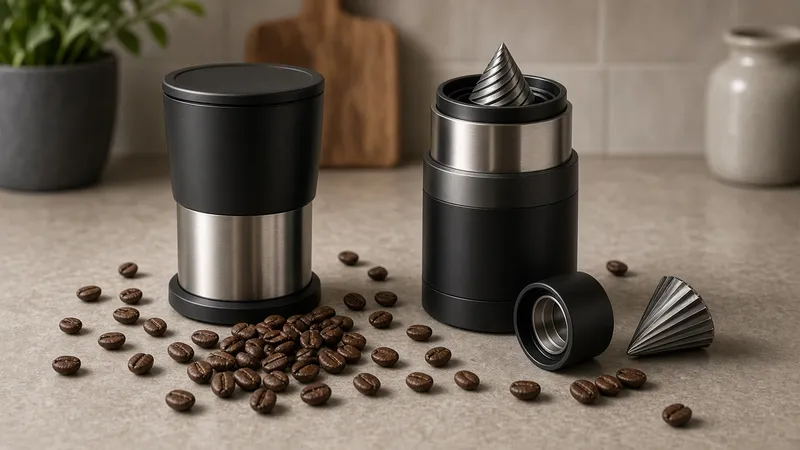
Burr grinders crush beans between two abrasive surfaces set a fixed distance apart, so they produce much more even grounds than blade grinders, which chop beans with a spinning blade. Even grounds make flavor easier to control. For drip, pour-over and French press, an entry-level electric or hand burr grinder works well. Espresso needs a grinder that can make very fine, small adjustments. Look at burr type (conical or flat), adjustment steps, motor speed, retention and how easy it is to clean.
- Blade grinders chop beans unevenly; burr grinders crush between two surfaces at a set gap.
- Conical and flat burrs both make consistent grounds.
- Burr size, material and adjustment range are the key specs.
How each grinder works
| Feature | Blade grinder | Burr grinder |
|---|---|---|
| Mechanism | Spinning blade chops beans | Two burrs crush beans at a set gap |
| Grind control | Time-based only | Adjustable setting |
| Consistency | Mix of dust and chunks | Much more even |
| Heat | Can warm beans with long runs | Low to moderate |
| Price | Low | Wide range |
| Best for | Spices, occasional coffee | All brew methods |
Uneven grounds extract unevenly. Fine particles over-extract, which tastes bitter, while large chunks under-extract, which tastes sour. That's the main reason burr grinders produce more controllable coffee.
Burr types
Conical burrs
A cone-shaped inner burr turns inside an outer ring. Common in hand grinders and many electrics, they tend to run at lower speeds.
Flat burrs
Two parallel rings face each other. Common in many espresso and specialty grinders, they come in a range of diameters.
Burr material
Most burrs are steel, sometimes with coatings. Ceramic burrs are common in budget hand grinders and resist corrosion, but can chip if a stone gets in.
Burr size
Larger burrs usually grind faster. Size alone doesn't determine quality.
Specs to compare
| Spec | Why it matters | What to look for |
|---|---|---|
| Adjustment type | How finely you can dial in | Stepped with many steps, or stepless |
| Number of steps / range | Covers espresso to French press? | Check the listed range |
| Motor speed (rpm) | Heat and noise | Lower rpm common in quieter grinders |
| Retention | Freshness, waste | Low retention, single-dose design |
| Hopper size | Convenience | Smaller hoppers suit single dosing |
| Static | Mess | Anti-static features, small water spritz (RDT) |
| Cleaning | Taste over time | Removable burrs, brush included |
| Noise | Early mornings | Check reviews and spec sheets |
See the grinders on the deals page.
How to choose
1. Your brew method
Filter-only drinkers can use grinders without fine espresso adjustment. Espresso drinkers need fine, precise control.
2. How many cups
Hand grinders suit one or two cups. Electric grinders save time for larger batches.
3. Budget split
Many coffee guides suggest putting more of your budget into the grinder than the brewer. See Building a first coffee kit: grinder, brewer and upgrades.
4. Counter space and noise
Check dimensions and noise levels for small kitchens or early mornings.
The brew matcher can suggest a grinder type for your method.
Common mistakes
- Buying an expensive brewer with a blade grinder.
- Grinding long before brewing. Ground coffee goes stale quickly.
- Never cleaning the burrs. Old oils affect taste.
- Using rice to clean burrs when the manufacturer warns against it. Some makers sell grinder-cleaning tablets instead.
- Adjusting while empty on grinders whose manual says to adjust while running. Check the manual.
Care and safety
- Unplug before cleaning or removing burrs.
- Brush burrs and chute regularly, following the manual.
- Keep hands and utensils out of the chute while it's running.
- Watch for stones in beans. Most grinders aren't built to handle them.
What “espresso-capable” must mean
Espresso needs fine grind and small adjustment steps. Marketing that says “works for espresso” without fine resolution often frustrates dial-in.
Look for stepless or high-step-count adjustment, suitable burr geometry, and a workflow that doses consistently (single-dose or reliable hopper feeding).
Pairing notes from Baratza and similar maker docs beat generic Amazon adjectives.
Retention, clumping and distribution
Retention mixes stale grounds into fresh doses. Single-dose workflows and bellows aim to reduce that. Midrange grinders vary widely here — read maker claims critically and plan a purge ritual if needed.
Clumping at fine settings is common; WDT-style distribution tools and careful puck prep help machines more than another chrome accessory.
Matching grinder to machine class
Pressurized baskets forgive weaker grinders. Non-pressurized baskets expose every grind defect — budget accordingly.
Built-in grinders on machines like Barista Express-class units must be evaluated as the grinder half of the purchase — Beginner espresso: setup, dial-in and milk workflow.
Single-dose vs hopper
Hoppers are convenient for daily drip. Single-dose reduces stale beans in the machine and retention between coffees.
Features that help filter brewing
Clear medium/coarse markings, low static if possible, easy cleaning access, and a catch bin that does not dump fines everywhere.
Timer-based dosing on some electrics helps repeatability for drip baskets.
What you can skip
Espresso-only accessories, huge hoppers you will not fill, and ultra-premium burr swaps before basics are solid.
A scale does more for filter consistency than a second decorative dripper — Pour-over guide: technique, kettles and scales.
FAQ
Is a hand grinder good enough?
For one or two cups of filter coffee, many hand burr grinders produce even grounds and cost less than electrics of similar quality. They take effort and time, especially for fine espresso grinds.
Conical or flat burrs: which is better?
Both can grind very well. Differences show up more between quality levels than between shapes. Flat burrs are often linked with clarity in the cup and conicals with body, but these are general tendencies.
What is retention?
Grounds that stay inside the grinder after grinding. High retention means stale grounds mix into your next dose. Single-dose grinders aim to keep it low.
Can I use a blade grinder for espresso?
Not really. Espresso needs a fine, consistent grind and very small adjustments, which blade grinders can't provide.
Next step
After Coffee grinder buying guide: burrs, blades and method fit, skim the glossary or the hub index.
Sources
Spec notes for Coffee grinder buying guide: burrs, blades and method fit are compiled from maker docs and public references — not a hands-on review. Confirm live specs before buying.